Discussion and news about the modern effort to understand the nature of life on Earth, finding planets around other stars, and the search for life elsewhere in the universe

Wednesday, July 14, 2010

Altogether now

The issue of multi-cellular life is very, very interesting. A number of years ago Carl Zimmer wrote a very nice piece discussing how, when, and why microbial life on Earth got to acting in a multi-cellular mode. Interestingly, the organism he talks about is the self-same alga - Volvox - that was the subject of the genetic detective work I mentioned in the last post. What I find so fascinating about all this (hence the sudden flurry of posts), are the broader implications for life elsewhere in the universe. This is also motivation for the kind of hare-brained social gaming experiment I suggested last time.

In astrobiology there is ongoing debate about just how unusual, or not, so-called 'complex' life might be out there in the cosmic deeps. A lot of the discussion got rounded up in Ward & Brownlee's book Rare Earth, where they tried to argue the case for our homeworld, and its biosphere, being particularly special. I couldn't help but feel at the time, and more so now, that this line of reasoning was overly mired in the increasingly archaic view that evolution is this rather inflexible progression towards 'complex' life. I think it underestimates the sheer opportunistic side of biology. We also get so blinkered by the historical and sociological context of the development of evolutionary biology that we come to see 'complex' life as a veritable house of cards. One wrong step, one asteroid too many, one poor mutation, and a planet will be forever bereft of multi-cellular life.

As Zimmer discusses, the transition between single-celled, microbial organisms and multi-cellular life has happened multiple times across different phyla during the Earth's history. It occurs as and when the advantages of being 'big', outweigh the advantages of being 'small' - jolly old natural selection. Now, here's the next bit of wide-eyed speculation [and yes, I know, countless sci-fi tales got there first...]. Does multi-cellularity necessarily mean physical connection? While there is certainly a lot of physics that can be exploited by getting together on a microscopic scale (even quantum entanglement in photosynthesis), there may equally be advantages to remote connection. And, while I really don't want to go all starry eyed here, an informationally nutritious medium like the Internet, could provide just the kind of connectivity such life would require - hooking together the individually sophisticated human microbes. Is the internet part and parcel of the evolution of life on Earth? Well, I might not go quite that far, but could a mechanism of long-distance, but intimate, connection occur in a purely biological system?

Obviously if you're James Cameron and you live on an allegorical moon called Pandora then the answer is yes. But for astrobiology it may not be crazy to relax the rules for what is meant by 'complex' life. The next question would be whether the planet-wide signatures of dispersed multi-cellular life would look any different than those from the types of life we know about.

Tuesday, July 13, 2010

Microbes..who, us?

Stewing in heat-waves, rain, and who knows what else. Summertime in the northern hemisphere of the planet is a good time to wallow in a bit of speculative thinking. A couple of posts ago I talked about a fabulous piece of work on what could be a 2.1 billion year old example of emerging multicellular life here on Earth. Hot on the heels of this is another study of the origins and mechanisms of multi-cellular organisms. The paper, by Prochnik and collaborators, examines genetic evidence for the history of multi-cellular behavior in a type of algae.

The bottom line is that the algae seems to have very, very similar genetic building blocks to its most similar single-celled, microbial relatives. Specifically, the protein toolset doesn't alter much between the single guys and the multi-cellular descendants. What this means is that it wasn't some giant leap to move to a multi-cellular, or communal, existence - at least for these species. To use the terminology of the study, these organisms are not particularly innovative - with a bit of an evolutionary shrug of 'oh what the heck' they segued into a new multi-cellular mode of life. Of course I exaggerate, but it does seem that this was not some earth-shattering, Charlton Heston type, moment in ancient biology. The same tools can be used to fashion a new type of life.

Which brings me to the summer speculation. Here we all sit gazing at our screens, our little brains and hands pawing at the pixels and keys. Each of us is quite uni-cellular in that sense, self-contained, sending out feelers and sensors, pulling in environmental information. The medium that we are immersed in may be a virtual one, packets of electrons whizzing to and fro across the world, but it's arguably just as good as a nice bit of pond water, or agar gel.

Then something happens. Perhaps it's an earthquake, a political event, a particularly enthralling YouTube video of cats licking themselves. Whatever it is, it can serve to motivate a sudden shift of mode for thousands, if not millions of individuals. Instead of solitary action we can form a mob, whether by just pinging the same page, sharing on Facebook, emailing everyone we know, or actually hopping on a bus and going to a demonstration. The internet has made this type of behavior far, far, easier. Each of the cells may not think they're part of a larger organism, but by most standards they are. Social gaming is another excellent example - 'help me grow my carrots by clicking here' - if that isn't inter-cellular communication to perform function then I don't know what it is.

So, here's the proposal, for all you bored but brilliant programmers. How about making a social game that is actually a cunningly disguised attempt to build a virtual multi-cellular lifeform? All of us single-celled organisms will just use our familiar toolsets to participate, but in doing so we will create and evolve something new, much bigger than the sum of the parts. The point of this - other than lowering office productivity - would be to perform a scientifically useful experiment to learn about the types of networks and 'global' mechanisms involved in shifting from uni-cellular life to multi-cellular. We might, just might, gain insight to this transition...

[oh, and I'm sure someone else has thought about this before...]

Friday, July 9, 2010

Our leaky solar system

We've all grown up with the notion that we're a long way from the nearest stars. This isolationist mentality extends to the way we think about all the stuff in our solar system; it's ours, all ours! However, our Sun almost certainly formed together with many other stars from the same cloud of molecular hydrogen, with the usual sprinkling of heavier elements and interstellar dust. Long since dispersed by the inexorable slewing of material as it lumbers around the Galaxy - every 210 million years or so at our placement from the galactic center - our stellar brothers and sisters may be well scattered by now.

There was a time though, some 4-6 billion years ago, when other stars, likely with their complements of dusty planet-forming material, could have swept by. The absolute outermost reaches of our local gravitational well are populated by the cold residue of planet formation, the objects we know as cometary nuclei. This postulated fuzz of stuff is the Oort cloud, and should extend outwards from us to as much as 100,000 astronomical units distance - almost halfway to the closest stars of Alpha Centauri.

An intriguing new work by Levinson et al in this weeks Science re-opens an investigation into the precise origin of the Oort cloud. From what we know about long-period comets, sailing in from this distant population, there appear to be some serious discrepancies about the likely number of objects out there in our deepest reaches. Their basic argument is that there are too many objects in the Oort cloud to be accounted for by their origin around the giant planets - from where they were gravitationally flung outwards during planet formation 4.5-5 billion years ago.

The rather shocking alternative, carefully studied with state-of-the-art computer simulations, is that as much as 90% of the Oort cloud has actually been gravitationally captured from other stars, during close passes billions of years ago. Equally, we've shed plenty of icy lumps that are now stuck with different stars - somewhere along a common path around the galaxy.

With a wave of the wand our solar system is less of an isolated specimen than a separated sibling, carrying along the familial baggage of our stellar birth cluster. This means that some of the long period cometary bodies that spew their guts as they dip towards the Sun are truly alien - born around another star altogether. As a small habitable planet, we get the occasional wash from this material, and the occasional collision. Whatever the chemistry and isotopic mix is of these ancient objects, it's slowly getting mixed into the inner solar system. Remarkably this means that there is a pathway that could conceivably take a molecule formed around a giant planet in another star system and eventually deposit it in your Pina Colada. Anyone for another round?

Friday, July 2, 2010

Original multicellular life

We are cellular clumps. Great big, sticky, masses of about ten trillion cells, plus our microbial passengers. Although they all operate in unison, our cells are each quite self-contained. Membranes hold together our 3.3 billion base-pairs of information packaged up tight, and all manner of other molecular structures that allow the cell to hum away like a tiny machine. On the other end of the spectrum are the microbes, where an entire living organism is encapsulated in one single cell.

Somewhere in-between is a fascinating and tricky regime. Most microbial life - bacteria and the ancient archaea - live in colonies, typically of many, many different species. They communicate, they glue together in biofilms, they both support and rely upon each other. It is so very tempting to look at this and see how life on Earth went from these single-celled characters to multi-cellular grandeur. It's just a matter of joining the dots - literally.

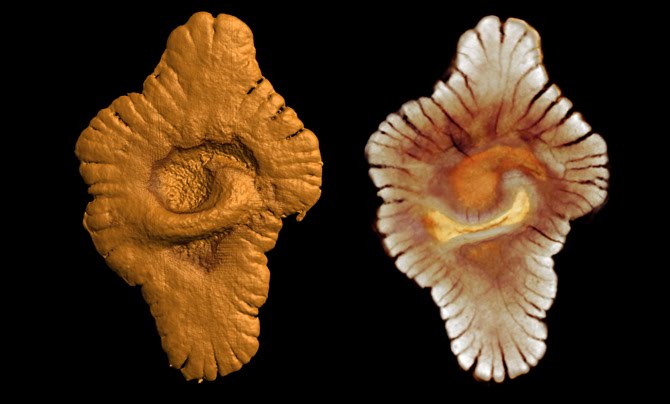
Fossil evidence for when and how multi-cellular life on Earth first reared up has been awfully tough to come by though. Small squishy things do not take well to billions of years of mineralization. It does seem to have coincided rather broadly with the time at which Earth's atmosphere began to load up with significant amounts of oxygen about 2.4 billion years ago - courtesy of photosynthetic organisms like cyanobacteria. Available oxygen, while toxic to much of microbial life, opens up a whole new, energetically favorable, chemical network - a big tipping point towards large and complex lifeforms. A fabulous paper appeared this week in Nature, by El Abani and collaborators, along with a nice opinion piece by Donoghue & Antcliffe, describing perhaps the closest thing yet to our multi-cellular ancestors - hot on the tail of the oxygenating Earth.

In this paper they report fossil remains of curious looking, bumpy, swirly, scallopy characters as big as 12 centimeters, from what is now Gabon. At 2.1 billion years old they land on the cusp of atmospheric transformation. Carbon and sulfur isotopes seal the deal on these being biological in origin (see my other post). Everything about these objects screams cellular colony. Does that make them multi-cellular? Well, incredibly, the patterns in these fossils strongly suggest that the type of cell-to-cell communication that is the hallmark of creatures like ourselves was at play.

So here we are, meet your great-to-the-power-of-nine-aunt. In the search for life elsewhere in the universe we often come up against the question of whether 'complex', multicellular life is going to be rare or not. Certainly its longevity on planets probably comes down to fine details of environmental stability. However, if microbial life can gentle slither into this mode of operation - like our friends from Gabon seem to be doing - I think it ups the odds that for at least part of a biosphere's history, multi-cellular type life will be around. Perhaps we should think of life like us more as a desert bloom - it may happen only briefly when conditions are right, but the potential is always there.

Monday, June 28, 2010

Favorite nuclear flavors


One of the signposts of life - and something that will likely be exploited in the study of potential Martian critters - is isotopic fractionation. The general wisdom is that life prefers light isotopes. Given the choice between hydrogen and deuterium (always present due to its construction 13.7 billion years ago during primordial nucleosynthesis) living things will tend to choose the lighter hydrogen. The same is true for carbon-12 and carbon-13, the light guy wins and is preferentially incorporated into the chemical doings of cells. When the extraordinary plumes of atmospheric methane were confirmed on Mars a couple years ago it was clear that the next step would be to try to pin down the isotopic composition of the gas. Here on Earth one can quite readily distinguish methane produced by bacteria or archaea and that produced by abiotic processes (most is biological), by tasting the isotopic composition.

So why is this so, why does life like particular isotopes. Ask a biologist and they will typically say that it's all about enzymes. Processes inside cells that work with enzymes - fabulous catalysts - happen faster with light isotopes, and bingo, you naturally sieve out the heavy guys and leave them in the dust. At least that's the line I've heard again and again. I was fascinated then when I stumbled across a very interesting work by Calsciotti. In this and subsequent papers the discovery of cellular processes involving nitrogen are described that actually prefer the heavy isotope nitrogen-15 rather than the lighter nitrogen-14. It appears that in some cases the heavier atoms provide a more energetically lucrative reaction route, et voila, like the fickle thing it is, life spits out the lighter variants in favor of something meatier.

The light isotope rule is not even that. Biochemistry again demonstrates that after a few billion years of fine-tuning it can exploit just about any trick in the book to get ahead. What I find amazing is that only about 0.4% of nitrogen on the Earth is the weightier 15, yet here we have organisms that will make use of the better chemical throughput of that isotope. One's first reaction is 'why bother?'. Obviously it may just be an unintended consequence of the chemical network, but I think the odds are good that somewhere along the line that tiny advantage will have been important. Here's the big question though, would a different biosphere - a martian one perhaps - with a presumably different evolutionary history, make all the same biochemical choices? To throw a final spin on this; Mars has a higher nitrogen-15 abundance than the Earth, a relative enrichment of about 60%. How much would this environment have swayed things?

Wednesday, June 23, 2010

Planetary fumigation

Where do you go on Mars to look for life ? Some pretty big decisions are looming for NASA's next Mars rover - the plutonium powered, SUV-scale beast known rather delicately as Curiosity. The choice of landing sites is currently down to four, and much depends on clues to the past history of these regions. Some show signs of a watery era, with the possibility of rich sedimentary rock - the kind of places where the detritus from an ancient martian biosphere would have ended up. Curiosity will be armed with an array of instruments, some capable of analyzing the detailed organic chemistry being trampled underfoot.

There has been considerable debate in the community about where to land, how to avoid chemical and even biological contamination of where you land, and exactly what instruments to carry - given the very real limitations to hauling every gram of gear to Mars. There's no doubt that Curiosity represents the next great stage in exploring another planet, and looking for the signs of extinct, or even extant, life. We'd like to get it as right as possible.

Thinking about all this raises something else, that gets less attention. There is a supposition that if Mars once had a watery surface environment - even if only fleeting - and some kind of biosphere, then there must surely be traces left. Obviously the geochemical alteration of the surface is likely to be noticeable, but why do we assume it is hard to erase the signs of life from a planet ? It may be an Earth-centric bias.
What would it take to erase life from the Earth, and perhaps also any sign that it was ever there ?

For everything on the surface then we can imagine burning, exploding, acidifying, and irradiating until we had just an amorphous, crispy, residue that would be entirely sterile and uninteresting. However, then there's the subsurface - kilometers deep rock, oceanic sediments and porous material, isolated subterranean water. All of this is chock full of slow-living microbial life. A solution would be to 'go Venus', melt the surface and keep up strong volcanism for billions of years - heat and pressure over time will transform just about anything. Time alone might do it. If you could wait another five billion years or so (at which point the Sun will have engulfed the Earth anyway) then perhaps enough of the molecular handprint of life will have fizzled away to be unrecognizable. In short, without a cataclysm then it's hard to imagine a way to remove all traces of past or present life on Earth.

But what about Mars ? If a planet never gets a fully entrenched, deeply embedded biosphere does it retain the same stain ? Suppose for a while, in the distant past, Mars did have a wetter and more obviously nurturing surface environment. Perhaps microbial life got going across a number of optimal regions, but was then cut off - as if life on Earth had stopped 3 billion years ago. It seems it would be much easier for time and chemistry, not to mention volcanism and asteroid impact, to lay down the white-out. It sounds pessimistic, but it's really more about tackling the fundamental problems of molecular paleontology - you need to find an understanding of what might be blocking your view in order to reconstruct what was once there...

Monday, June 21, 2010

Swings and roundabouts

The hunt for terrestrial-type planets is hugely challenging, although steady progress is being made. Last week NASA's Kepler mission finally began to release data on some of its candidate planet-hosting stars. In a bit of controversial, but to some extent understandable maneuvering, the Kepler team has kept what are probably the juiciest systems to themselves. The New York Times had an excellent piece on this tale. Regardless of what data any of us get our sticky paws on there is still a big hurdle to deal with. Kepler is seeking the tiny dips in starlight when planets transit their stellar hosts, but this alone is not enough to either confirm with absolute certainty the presence of a planet, or to determine the mass and detailed orbital characteristics of new worlds. The next stage involves painstaking followup with ground-based telescopes equipped with exquisite spectrometers, seeking the wispy signs of Doppler shifting starlight due to the gravitational offsets induced by planets.

It's quite a bottleneck. It's also pushing the limits of experimental sensitivity as we seek planets equivalent to the Earth - where the stellar 'wobble' can be mere centimeters per second, the speed of a royal wave. Kepler hasn't even got to those candidates yet, with orbits close to 12 months in length we need the next several years to witness multiple  transits. There is no doubt that it will take a great amount of scientific cooperation and effort to finally nail down the number of Earth-equivalent worlds that Kepler sees.

Even then, what we'll end up with is really just (although 'just' is relative) a well defined estimate of how many such planets should exist galaxy-wide - together with some idea of their typical compositions and orbits. Bottom line is that the newspaper banner in three or four years will read something like '15 %' - this being the fraction of normal stars hosting small rocky worlds. Is that worth the $600 million for Kepler, plus many more millions for all the followup work ? Such is the nature of modern fundamental science. The Large Hadron Collider costs well in excess of $6 billion, that's about a billion per physics question that it might help answer. The overall cost of the Human Genome Project was about $3 billion - roughly a dollar a base-pair.

I'd argue that by comparison Kepler is positively efficient, but it does raise an interesting question. Just how much are we as a species willing to invest in the search to find other worlds and to seek out signs of other life in the universe ? It's not a cheap enterprise. For me though it is no less important than understanding fundamental physics, or our genetic blueprints. In fact I'd stick my neck out and suggest that unless we find new worlds, new biospheres, we will never have a way to place the Earth and ourselves in proper scientific context. The answer to our origins will come from seeing the bigger picture, and that is surely cheap at any price.