Discussion and news about the modern effort to understand the nature of life on Earth, finding planets around other stars, and the search for life elsewhere in the universe

Tuesday, August 24, 2010

Seeing red

Seventy percent of all energy consumed by life on Earth is in the form of solar photons. Interestingly this consumption is by a minority of organisms, those exploiting the mechanisms of photosynthesis. It amounts to a globally averaged energy intake of some 100 terawatts, but even this is peanuts compared to the solar input at the Earth's surface, which is about 90 petawatts. By comparison, all available geophysical energy - thermal and chemical - is a paltry 30 terawatts.

If you want energy, then photons are the way to go. Catching and transducing photons into chemical energy in biological systems is accomplished via the extraordinary chlorophyll pigments. In oxygen producing organisms four types of chlorophyll had been known, each tuned to slightly different wavelengths. For example, chlorophyll 'a' grabs photons at around 465 nanometers (bluish visible light) and at around 665 nanometers (reddish visible light) - leaving behind the familiar green photons that we enjoy in our foliage. The other, rarer, chlorophylls absorb at similar wavelengths. Now, in a neat paper that appeared in Science last week, Chen et al. have identified a fifth chlorophyll 'f' - extracted from organisms lurking in modern day stromatolite formations.

Why get excited about this? Chlorophyll 'f' does something not seen before in photosynthesis - it slurps up photons from the near-infrared. At about 706 nanometers we're into a regime just beyond the visible. Obviously other pigments and structures can, and do, absorb photons in this regime, but only 'f' is known to actually use the photons to split water molecules - the key step in oxygenic photosynthesis.

To my mind this raises a number of fascinating connections to questions of life on Earth and beyond. It suddenly connects the dots to earlier indications of organisms exploiting infra-red photons around deep-ocean hydrothermal vent systems - or at least offers a molecular solution. It also, and here I'm heading out on a limb, might connect to an issue that's long bothered me. We've talked before about how our Sun was as much as 30% fainter three or four billion years ago. With this faintness comes a small shift in the peak output of a star's spectrum (being a blackbody to first order) towards the red. For the young Sun this would have only been a few tens of nanometers - but it would have meant a slightly better flux of these near infrared photons. In addition, a different atmospheric composition and chemistry on a youthful Earth could have altered the typical range of photons making it down to the surface. It seems not unreasonable to suspect that chlorophyll 'f' could have given ancient microbial life a leg-up over the competition. Indeed, did chlorophyll 'f' come along first?

It's pretty startling evidence of nature's capacity to find molecular machinery to exploit even low energy infra-red photons. Now picture a world around a low-mass star, with a drastically redder spectrum. Chlorophyll 'f' points the way to how organisms there might manage all the great tricks of photosynthesis that we see here on Earth.

Saturday, August 21, 2010

Protein universe

A couple months ago a rather stunning paper slipped into the journal Nature. It presents a sophisticated investigation of how quickly the genetic codes for proteins are evolving - across the 3.5 billion years or so of life on Earth.

The idea is that the specific genetic codes, the sequences of amino acids, that describe proteins - the workhorses of molecular biology - cannot withstand big changes, otherwise the complex structures formed will just not do their job properly. Swap in a different amino acid somewhere in a chain of a thousand and you'll no longer fold this big molecule up into the right shape, and you've gone from a 1/2 inch wrench to a pair of tweezers.

Over time though small changes can, and do, occur. As long as the final outcome permits the same job to be done by the protein, all is well. Now, let's suppose that a whole clutch of modern organisms share a common ancestor (something we've touched on before in these pages). We should be able to see just how different the protein coding has become since that time, and we should be able to tell whether this type of gentle evolution has stopped or not.

Povolotskaya and Kondrashov apply to proteins exactly the same methodology that Edwin Hubble did to the measurement of the expansion of the universe. They look to see how fast the coding is changing as a function of how different those proteins are - just as Hubble looked at recession velocities versus the physical distance between galaxies. What they find is that after about 3.5 billion years the protein universe here on Earth is still, slowly, diverging and expanding - it's not yet reached a true optimal state. They also point out that while 98% of locations in a protein sequence can't deal with quick tampering (change an amino acid there and the whole thing ceases to work), over billions of years you could more or less re-write the code for a given protein and get the same function. That's a bit like changing Hamlet by one word every new print run, until you have a totally different script, but the same outcome.

So, what says all this for the nature of life in the universe? These proteins plays roles in things like  metabolic processes that have remained unaltered for billions of years - solutions for how life extracts energy from its environment that are pretty close to optimal. Yet here we see a universe of slowly diverging, expanding, molecular structures - the very fabric of the biological cosmos on Earth. To my mind this might present a huge challenge to the notion of convergent evolution - the idea that there are a limited number of molecular or physiological solutions that life can use. Take a different planet, with a biosphere a couple billion years old. The stately evolution of its protein universe would almost certainly have taken a path unlike that here, exploring this vast multi-parameter space of molecular structures along alien paths. It both supports the notion of life as a potentially extraordinarily robust phenomenon, and as a hugely diverse one.

Thursday, August 19, 2010

The panspermia paradox

A brief hiatus and a lot of stuff happens - the oldest rocks on Earth, 3 million year old human tools, and future directions for astronomy. So, ignore all of that and bring focus to bear on a persistent idea. The notion of panspermia - the transferral of viable organisms between planets, and even between star systems and further.

There is no doubt that planetary surface material is continually being shipped around between rocky planets and moons in our solar system. Ejected by asteroidal or cometary impacts, chunks of stuff follow a range of orbital trajectories that result in both eventual return to their origins or transferral to the surfaces of other worlds. Increasing evidence suggests that a variety of (typically microbial) organisms could be carried along, surviving both the extremes of pressure and acceleration, as well as exposure to thousands to millions of years of interplanetary space. There is a real possibility for life to both cross-infect, and even to be 'seeded' from planet or moon to planet or moon.

Enthusiasts for panspermia go further, and have been known to invoke this as a mechanism for galaxy-wide dispersal of life - taking one rare occurrence of life and spreading it. There is however a factor that to my knowledge is rarely considered, and that is natural selection. You or I, fluffy bunnies, and daffodils are all unlikely candidates for interplanetary or interstellar transferral. The sequence of events involved in panspermia will weed out all but the toughest or most suited organisms. So, let's suppose that galactic panspermia has been going on for the past ten billion years or so - what do we end up with?

Although it's a complex problem, it seems likely that life driven by cosmic dispersal will end up being completely dominated by the super-hardy, spore-forming, radiation resistant, rock-eating (endolithic) type of critters. There will be no advantage to a particularly diverse gene pool. Billions of years of galactic transferral will have whittled it down to only the most indelicate and non-fussy microbes - super efficient, super persistent, and ubiquitous - the galactic top dogs.

Now, we might argue that there are many organisms on Earth that could fit the bill, and could be the links to these ancestral interlopers. The problem, and the potential paradox, is that if galactic panspermia is real then the type of life it will evolve should be everywhere. There would be stuff on the Moon, Mars, Europa, Ganymede, Titan, Enceladus. Every nook and cranny in our solar system would be a veritable paradise for these ultra-tough lifeforms. It may be too early to rule this out, but if life is sparse in our neighborhood then it would seem to argue strongly against the possibility of Galactic panspermia.

Saturday, July 31, 2010

Summer reading

It's not the usual post. A conversation about interstellar travel reminded me of a short, whimsical, piece of fiction I'd noodled with a while back. Nothing to do with the search for life in the universe, but much to do with the nature of long-distance travel, human enterprise, and that cosmic force; irony. So here goes, a little reading for the celestial beach chair.


Progress
All personnel. This is Mother, attention please. As you know we have now entered the Alpha Centauri AB system. The Santa Maria is adjusting for final insertion into a wide survey orbit. All navtechs and astros are to report to workstations and are reminded to follow United Federation survey protocols. Reactors three and four will begin shutdown as plasma drives are brought offline. Personnel generations six and seven are reminded that it is critically important to assist final generations with adjustment from interstellar environment. Counselors will be available to mediate. All children are to continue school on the normal schedule.

All personnel. This is Mother, attention please. Initial survey indicates two terrestrial mass inner planets around Alpha Centauri A, one with significantly non-equilibrium atmosphere, indicating potential biosphere. Gas giant b harbours two large moons, inner moon appears oceanic with high specular reflection. Access to Santa Maria spin axis recreational arenas and hydroponic fields will be limited, personnel are encouraged to remain on outer decks for g-acclimation. Colonization refresher courses will be available on deck nine. Exceptions will be made for centenarians and older.

All personnel. This is Mother, attention please. The Santa Maria will switch internal clocks to local frame in twelve hours. Elapsed journey time will then be 1,015 Earth years, eight Earth months and three Earth days precisely. Wide band modulated transmissions have been detected from terrestrial planet c, precise nature of transmissions has not yet been established. All anthropol personnel are to report to workstations and follow contact protocols. Counselors will be available on decks seven through ten.

All personnel. This is Mother, attention please. Contact has been established with planet c. Personnel of the United Federation interstellar cruiser Vixen have established a colony there during the past ten years. Colonists report that a quantum-entanglement drive was developed during year 950 of Santa Maria journey time. Vixen departure from Earth was during year 980 of Santa Maria journey time. Counselors will be available on all decks until further notice. Anti-depressants will be made available following consultation with assigned medical personnel.

All personnel. This is Mother, attention please. Arrival two hours ago of the United Federation interstellar scout-class Sabre was responsible for strong electromagnetic pulse. All primary systems are fully functional, secondary systems will be back online shortly. The singularity worm-drive onboard the Sabre was developed during year 995 of Santa Maria journey time. The Sabre is now deploying its colonist transports to gas giant b ocean moon. Personnel are advised to join counseling groups on all decks.

All personnel. This is Mother, attention please. The results of the Santa Maria referendum on proposition 1A have been tabulated. Santa Maria will be refurbished with a singularity worm-drive and upgraded habitat resources. Cryochambers will be added to deck five for optional suspension and all interior living areas will be resurfaced and modernised. Generations six through eight will disembark and join Vixen and Sabre colonists on planet c and the gas giant b ocean moon. Remaining generations will retrain for the journey to Barnard’s Star, anticipated to take only fifteen years. Congratulations as you begin this historic voyage as the next colonists to another star. Legal counselors are available on decks two through five to assist in waiver statements with regard to the United Federation’s limited liability for your first arrival status at Barnard’s Star.

(c) C. Scharf (2010).

Tuesday, July 27, 2010

Planetary Prometheus

Imagine, if you will, a planet with atmosphere, oceans, rocks and life. On this planet then most chemical reactions are either slow and geophysical, or quick and biological but very localized. There is however an exception. Because of the particular nature of this world there is the ever-present potential for a type of chemical reaction that is not only fierce and destructive, but self-propagating. Once triggered it can spread across hundreds, even thousands, of square miles. It preferentially attacks and transforms living material - leaving behind a fragile deposit, stripped of most biomatter. It can only stop by either exhausting the supply of fresh reactants, or when its chemical energy is sucked away by an un-reactive medium.

This is a tricky planet. It forever teeters on the edge of letting this chemical storm get a grip, but its climate and varied topography help to confine outbreaks. The very compounds responsible are themselves critical ingredients for much of the life on this world, and cannot be eliminated. Indeed, the reaction itself serves a number of key roles in stabilizing populations, cycling elements between air, ground, and oceans, and is ancient enough to have been incorporated into the survival strategies of large numbers of species.

Imagine we could visit this world. Entering orbit we would scan it with our telescopes. Curiously, at any given time, we would observe tens of thousands of these intense chemical maelstroms dotted across the globe. Their signatures would be quite distinct, and we might be quite astonished that life existed in such a perilous environment.

Of course, this is no hypothetical planet. It is the Earth. The chemical reaction we know as fire is a strange and intriguing, and often overlooked, aspect of life here. The young Earth of 3 billion years ago, with little or no oxygen in its atmosphere, or flammable biomatter, would have probably only seen fire in volcanic settings. Somewhere along the line, maybe a billion or two years later, with enough free oxygen, perhaps some dried up mat of plant life on a tidal shore was the first victim of arson - possibly a result of lightning. Today, fires cover the globe. Satellite imagery, or remote sensing, tells the story. The image in the upper left shows thousands of fires scattered across south-central Africa, seen by the MODIS instrument on NASA's Aqua satellite. Many of these have been set by humans, following an ancient pattern of land-use. Humans have learnt to exploit this chemical fragility.

I think we tend to underestimate the chemical reactivity of our homeworld. Fire is an excellent example - it's so familiar to us that we (well, I) even have to pause to remember that it's something chemical, fiercely exothermic. It raises a number of interesting questions. Is a phenomenon like fire simply a consequence of the kind of chemical reactivity needed for a planet to harbor life? Life on Earth needs a lot of reduction-oxidation pathways. Can you propel a biosphere to the kind of richness we see today without taking this walk on the wild side - risking destruction for the chance to make hay with oxygen?

Evidence suggests that, for example, around 270 million years ago atmospheric oxygen levels were significantly higher than today - and that fire was much more frequent on a global scale. More oxygen and it becomes hard to avoid burning all flammable materials, clearly there could be a feedback mechanism at play - complicated by geography and climate. Just how fire-prone can a planet become before it wipes out its surface biosphere?

Anyone got any marshmallows?

Monday, July 26, 2010

Exploding moss/Aquatic Mars

Trawling the scientific news and literature can be an obsession - there's just so much incredible stuff being discovered all the time. It's also hard to choose favorite items, whatever ability to prioritize that evolution has endowed humans with, it's not always very effective. So, with that by way of an excuse, there were two utterly unrelated items that popped up last week that I cannot choose between - your vote.

The first involves something I'd never thought of before. Terrestrial moss (yes moss), produces spores to propagate, since it is a flowerless and seedless plant. Spores are tiny capsules a few tens of micrometers across and are perfect for being dispersed in the air. The puzzle has been that when the wind blows on Earth there is usually a small layer of atmosphere, about 10 cm wide, that serves as an interface between the planet surface and the free-flowing air. If you want to be carried off by the wind you need to get above this layer that's a result of friction, fluid dynamics, and topography. Most mosses lurk no more than about a centimeter above the ground - so how do they get their spores into the mossy equivalent of the jet-stream?

A paper by Whitaker & Edwards in Science examines the problem, and with ultra-high speed photography they find that some mosses use pressurized, explosive, capsules of spores to launch them upwards with g-forces of as much as 30,000. Although this is impressive, as lilliputians it results in a roughly 30 mile-an-hour Vespa-like launch velocity. The puzzle is that even this shouldn't get the spores high enough. The new study provides the answer - the exploding capsules are such that they produce a spore-laden vortex ring that burrows its way up to the magical 10 cm altitude. It's very much like a smoke ring, a complex structure that maintains integrity. In effect, natural selection has endowed moss with both a knowledge of the bigger picture of terrestrial atmospheric science, and some fluid mechanics that Boeing would envy. It's a further reminder that even 'simple' life is seldom just that.

One then wonders if a planet like Mars once had spore launching organisms littering its surface. A new paper by Morris et al. fills in one of the blanks. With all the geological evidence that Mars was, at least for a time, a wet place there has remained a bit of a conundrum. The simplest way for Mars to have been more temperate was for it to harbor a thicker, carbon-dioxide rich, atmosphere - with a strong greenhouse effect. If that had ever happened then there should be massive amounts of carbonate rich rocks laying around from that era. Until now the evidence for this had been scant. By studying the walls of Gusev crater with the Spirit rover Morris et al. get a look at the geological history - and they have now identified significant, and ancient, carbonate deposits from about 3.5 billion years ago. Checkmark the box.

It's not the end of the story, but it adds significantly to the evidence for a warm, wet, young Mars. The next question is how long did it retain this climate - long enough for life?

Wednesday, July 21, 2010

On the iceberg

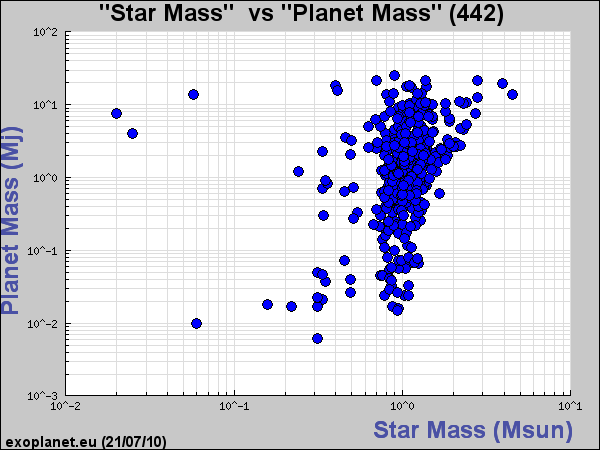
Although incredible progress has been made in the search for exoplanets, we're still teetering on the peak of the cloud enshrouded mountain, with little real knowledge of what lies beneath. It's instructive to take a look at where things are at today. The first image here (go on, click on it) is a plot of estimated planetary mass (typically a lower limit owing to the nature of the detection techniques used) versus the estimated distance of the stellar parent. A total of 448 planets are pulled out of the excellent exoplanet catalog. Not bad going for 15 years of effort - although it is sobering to realize that our galaxy alone almost certainly contains more than a hundred billion objects we'd term planets - and likely many more. So far the majority of our detected planetary swarm is within about 100 parsecs - about 330 light years - of the Sun. A keen eye will spot that the lowest mass planets, a few hundredths of the mass of Jupiter - the unit used on the Y-axis - also lurk preferentially in some of the closer systems. This is an artifact of the choices made in investigating systems and the nature of planet detection methods.

This 2nd plot (minus a couple of systems) reveals some more of that skewness. The low mass planets at the bottom also correlate with stars that have a slightly lower average mass than those higher up in the plot. Lower mass stars are more strongly perturbed by the gravitational tug of orbiting planets, so the telltale signs of small planets are easier to find - but they're also fainter, and so they are better targets when they're not too far away.

This lower left corner is one of the most intriguing places to go looking for planets. An astonishing 70% of all stars in our Galaxy are less than half the mass of the Sun. There are at least 300 such objects within 10 parsecs of us. They're the real dwarfs, some are a thousand times fainter than the Sun, but they can burn their nuclear fuel for a trillion years. If planets - at least the smaller rocky ones - can form efficiently around these stars, then most worlds in our galaxy, and indeed the universe as a whole, will be bathed in their reddish light. The next few years should reveal more about the closest examples, and their alien environments.